
CERN Discovers New Pentaquark State
Physicists at CERN's Large Hadron Collider have identified a never-before-seen pentaquark configuration, a step toward understanding how quarks bind together in exotic combinations beyond ordinary protons and neutrons.
ScienceGNGV Editorial Team5 min readLast reviewed September 28, 2026
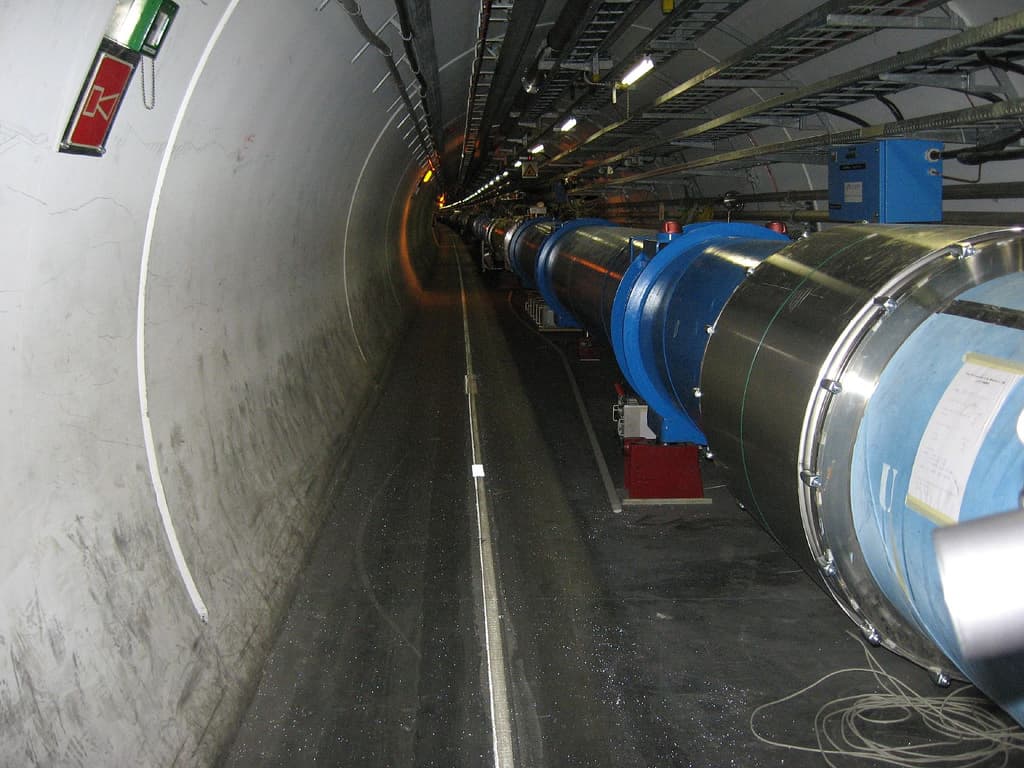
Physicists working at CERN's Large Hadron Collider have announced the discovery of a new pentaquark state — a particle made of five quarks bound together in a configuration never previously observed. The finding, published this week, adds a significant piece to the puzzle of how the strong nuclear force operates at the most fundamental level.
Pentaquarks were first confirmed in 2015, but the new state features an unusual combination of charm and strange quarks arranged in a way that challenges existing theoretical models. The particle was detected by analyzing decay patterns from billions of proton-proton collisions at the Large Hadron Collider.
The discovery is particularly exciting because it suggests that quarks can form stable bound states in more diverse ways than previously thought. Standard matter — everything we see around us — is built from particles containing either two or three quarks. Pentaquarks, with their five-quark structure, represent a fundamentally different way of organizing matter.
Dr. Liupan An, one of the lead researchers, explained that the new pentaquark appears to behave like a tightly bound molecule of smaller quark clusters rather than five quarks freely floating together. This molecular-like structure provides important clues about the strong force, which is notoriously difficult to calculate from first principles.
The implications extend to astrophysics as well. Understanding exotic quark matter is essential for modeling the interiors of neutron stars, where extreme pressures may create similar exotic configurations.
The researchers plan to continue searching for additional exotic states as the collider enters its next high-luminosity running period.